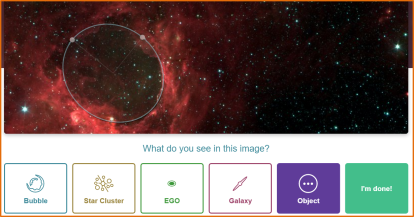
This blog post is an update to “Searching for Computer Simulated Bubbles in the Milky Way Project.”
Back in October 2017, the team at Cal Poly Pomona injected a bunch of computer-simulated bubbles into the Milky Way Project with the goal of measuring the completeness of the bubbles catalog. Now, we’re uploading a new set of images for our citizen scientists to classify: some containing a new set of computer-simulated bubbles, and some containing transplanted bubbles.
Why Completeness Matters
Why are we going through all this effort? Just to recap: the goal of this new phase of the Milky Way Project is to evaluate the completeness of the bubble catalog. We know how many bubbles our volunteers identified, and want to quantify how many bubbles might have been missed. This is especially true for smaller, fainter bubbles or bubbles located in very busy regions of the Galaxy. These bubbles would likely be much more difficult to identify, both by volunteers and by machine learning algorithms. In order to measure how many bubbles might have been missed, we can place known bubbles at specified locations in the images, and see what percentage of our citizen scientist volunteers find them. For example, if a certain small, faint bubble is only identified 50% of the time by volunteers, then we can infer that other comparably small and faint bubbles were only identified about half of the time. This would mean that, although there may be a thousand such bubbles contained in the final catalog, the actual number of small, faint bubbles in the Galaxy is about twice as large as our catalog would imply.
Our first attempt from October 2017 revealed that some of the simulated bubbles were too easy to identify. We’d like to thank our volunteers (especially @BLGoodwin) for pointing this out to us! It’s impossible to gauge completeness with a sample of bubbles that are easy to spot! So, we’re going for a second iteration that includes a brand new set of simulated bubbles and transplanted bubbles.
Transplanted vs. Simulated Bubbles
Transplanted bubbles are real bubbles that have been previously found by Milky Way Project volunteers (and will be included in the Data Release 2 catalog and paper). We give them a random rotation, and in some cases scale them to be smaller and fainter (in other words – what the bubble would look like if it were farther away), and then “graft” the bubble back into a Milky Way Project image. Numerous real bubbles have been selected, which span a large range in angular sizes, brightness, shape, and overall complexity. Some appear to have formed in relative isolation, while others are located in more actively star-forming regions of the Galaxy. Roughly 700 transplanted bubbles have been grafted back into the Milky Way Project and will form the foundation for our completeness study.
We are also including a second set of computer-simulated bubbles in our second iteration of this project. Just like with the first round, some of these may appear obvious – and that’s okay! Understanding why some of the computer-simulated bubbles look different from the observations (while other simulated bubbles seem to “pass” the visual inspection test) will provide our theorist colleagues with valuable information that can help improve their models.
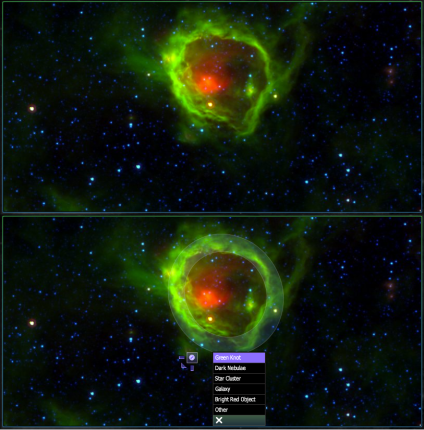
 This image contains both real and transplanted bubbles. Can you tell which is which?